
 Student Login

 Call: 407-345-0096
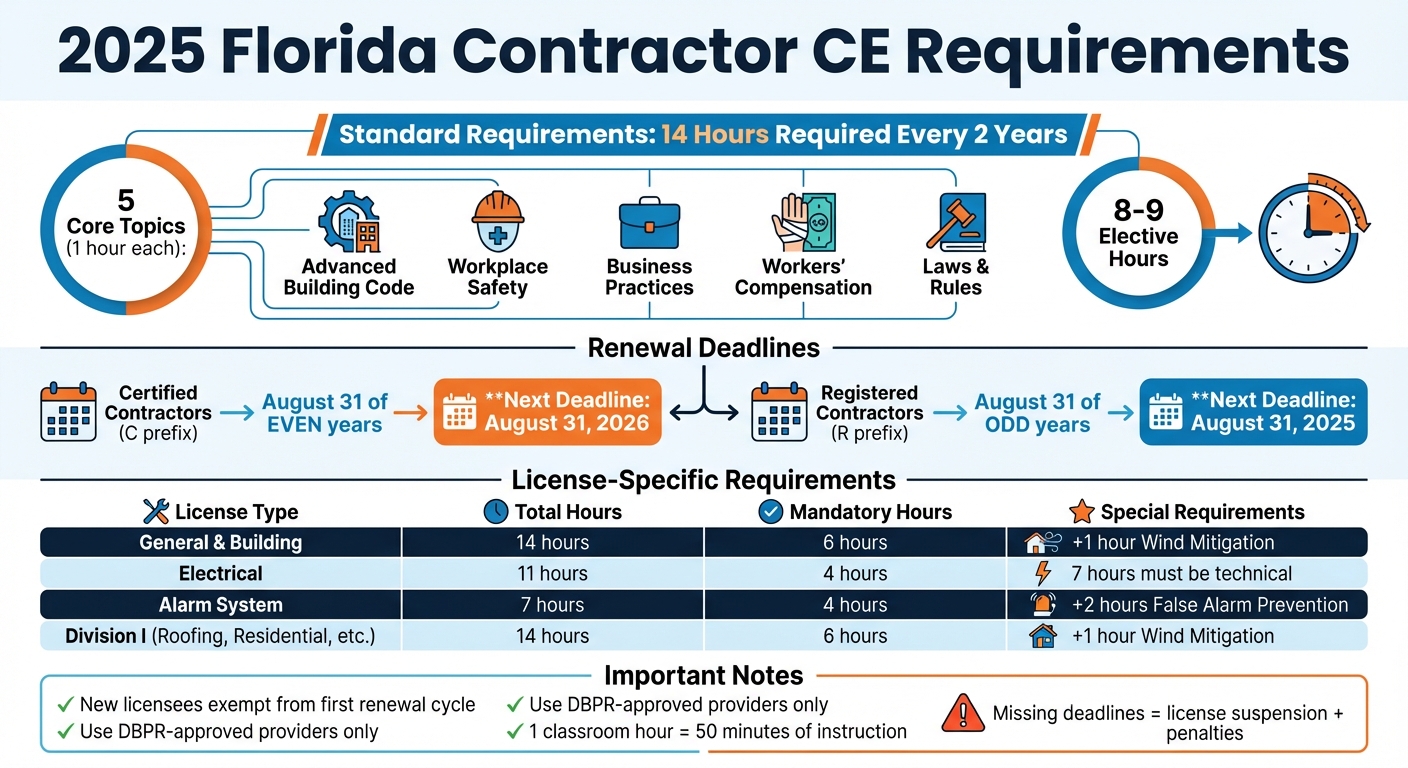
If you’re a Florida contractor, staying licensed means completing 14 hours of board-approved Continuing Education (CE) every two years. This applies to both Certified contractors (statewide licenses) and Registered contractors (local jurisdictions). Here’s what you need to know:
- Mandatory Hours: 5 core topics (1 hour each) covering Workplace Safety, Workers’ Compensation, Business Practices, Construction Laws & Rules, and Advanced Building Code.
- Additional Requirements: Division I contractors (e.g., General, Building, Roofing) need 1 extra hour on Wind Mitigation. Pool/Spa contractors require 1 hour of Pool Electrical training.
- Renewal Deadlines:
- Certified contractors: August 31 of even-numbered years (next: August 31, 2026).
- Registered contractors: August 31 of odd-numbered years (next: August 31, 2025).
- New Licensees: Exempt from CE in the first renewal cycle.
Complete CE hours via in-person, online, or distance learning courses. Ensure your provider is DBPR-approved and track your hours in your DBPR account. Missing deadlines can lead to license suspension and penalties. Start early to avoid last-minute stress.
CE Requirements Overview
Florida contractors must meet specific continuing education (CE) requirements as outlined by the Florida Construction Industry Licensing Board (CILB), which operates under the Department of Business and Professional Regulation (DBPR). These rules are based on Chapter 489, Part I of the Florida Statutes, which sets the standards for the biennial renewal cycle and CE obligations.
A “classroom hour” is defined as 50 minutes of instruction. So, when a course claims to be one hour, it includes 50 minutes of teaching. This distinction is helpful for planning, especially if you’re completing multiple courses in one day.
Contractors are required to complete 14 CE hours, which can be done through in-person classes, online courses, or interactive distance learning. If you opt for online courses, make sure the provider has a “C / I” or “I” designation to ensure your hours are accepted.
New licensees are generally exempt from CE requirements during their first renewal cycle. This gives newly licensed contractors a chance to focus on establishing their business before taking on educational commitments. Be sure to check the renewal deadlines specific to your license type.
Biennial Renewal Deadlines
Your renewal deadline depends on whether you hold a Certified or Registered contractor license. Registered contractors (whose license numbers start with “R”) must renew by August 31, 2025. On the other hand, Certified contractors (identified by a “C” prefix) follow a different schedule, with renewals due on August 31 of even-numbered years. Their next deadline is August 31, 2026.
Missing your renewal deadline can result in your license lapsing, which means you can’t legally operate. It may also lead to late fees and complications with insurance or ongoing contracts. To avoid these issues, it’s a good idea to complete your CE hours well before the deadline. This ensures your course provider has enough time to report your hours to the DBPR system.
Standard CE Hour Requirements
Most Florida contractors are required to complete 14 hours of CE during each two-year renewal cycle. This rule applies to both Certified and Registered contractors, regardless of license type. The 14 hours are divided into mandatory core topics and elective options.
The five core topics include one hour each of: Advanced Florida Building Code, Workplace Safety, Business Practices, Workers’ Compensation, and Laws & Rules. These five hours are non-negotiable. For Division I contractors – such as General, Building, Residential, Roofing, Specialty Structure, and Glass and Glazing contractors – there’s an additional one-hour requirement for Wind Mitigation Methodology, bringing their mandatory hours to six.
The remaining 8–9 hours can be used for electives or technical training. This flexibility allows contractors to focus on areas that align with their business needs, whether that’s advanced project management, emerging construction technologies, or specific trade skills.
Contractors with inactive licenses are not required to complete CE hours. However, reactivating an inactive license will require proof of 14 completed CE hours from the last or current renewal period. If you hold multiple licenses, you might be able to apply certain credits across different license types through cross-crediting.
To stay on top of your progress, track your CE hours through your DBPR account. While course providers are responsible for reporting your completed hours, it’s important to double-check that the hours are correctly logged in your account well before the renewal deadline. This extra step can save you from last-minute headaches.
CE Requirements by License Type
When it comes to continuing education (CE) for Florida contractors, the specific requirements vary depending on your license type. While most contractors need to complete 14 hours of CE, the exact courses and topics you must cover depend on your license category. These variations determine the mandatory subjects and how many elective credits you can choose.
General and Building Contractors
For General and Building contractors, the standard 14-hour CE requirement applies. Out of these, six hours are mandatory and include the following core topics: Advanced Module Building Code, Workplace Safety, Business Practices, Workers’ Compensation, and Laws & Rules. Additionally, contractors in this category must complete one hour focused on Wind Mitigation Methodology.
If you’re newly licensed, your CE requirements may differ based on how long you’ve held your license before the first renewal deadline. Here’s how it breaks down:
- Licensed for less than 12 months: You’re exempt from CE requirements for your first renewal cycle.
- Licensed for more than 12 months but less than a full renewal cycle: You’re required to complete only 7 hours of CE for your first renewal.
After that initial renewal, the full 14-hour requirement kicks in for all subsequent cycles.
Electrical and Alarm Contractors
The CE requirements differ significantly for Electrical and Alarm contractors compared to General and Building contractors.
- Electrical Contractors: They need to complete 11 hours of CE, with a strong focus on technical subjects – 7 of those hours must be technical. The remaining four hours are divided into one hour each for Workers’ Compensation, Workplace Safety, and Business Practices. Unlike Division I contractors, Electrical contractors are not required to take the Wind Mitigation Methodology course.
- Alarm System Contractors: Their CE requirement is only 7 hours per renewal cycle. This includes one hour each for Workers’ Compensation, Workplace Safety, Business Practices, and technical subjects, along with 2 hours dedicated to False Alarm Prevention. This additional focus aims to reduce false dispatches and foster better relationships with local law enforcement.
A unique benefit for Electrical contractors is the ability to apply certain technical CE hours to both their Construction Industry Licensing Board (CILB) and Electrical Contractors’ Licensing Board (ECLB) licenses. These tailored requirements allow contractors to address the specific challenges of their fields while aligning with Florida’s broader CE guidelines.
Required CE Course Topics
Florida’s continuing education (CE) program is designed to ensure contractors stay informed about key topics critical to their profession. These required courses focus on business, legal, and safety principles that directly influence your day-to-day responsibilities.
Workers’ Compensation
Every renewal cycle, contractors must complete one hour of workers’ compensation training. This course delves into Florida’s workers’ compensation laws, helping you understand employer responsibilities and reduce financial risks tied to workplace injuries.
This training isn’t just about meeting legal requirements – it also protects your business. As Metalcon highlights:
A strong workers’ compensation strategy can help metal construction companies reduce risk, retain skilled workers, and improve jobsite safety.
Additionally, tools like the Construction Policy Tracking Database can simplify compliance by sending automatic updates on coverage changes. These insights are invaluable for staying ahead of potential risks.
Workplace Safety
Workplace safety training ensures contractors are up-to-date with OSHA standards and Florida’s building codes. Topics include recognizing hazards, fall protection measures, proper equipment use, and emergency response protocols – essential knowledge for maintaining safe job sites.
Business Practices
The one-hour Business Practices course focuses on managing project funds, handling payroll, and making ethical decisions regarding employees and subcontractors. These lessons align with Florida’s CE requirements, equipping you with tools to run a compliant and financially stable business.
Trade-Specific Technical Topics
In addition to the core curriculum, electives are available to refine your trade-specific expertise. For instance, electrical contractors can explore the National Electrical Code, emerging technologies, or safety practices tailored to their field. Similarly, plumbing or HVAC professionals might choose courses on medical gas systems, backflow prevention, refrigeration design, or environmental considerations. These electives are a great way to stay current with advancements that directly impact your trade.
Palm Construction School CE Courses
Palm Construction School provides courses tailored to meet Florida’s continuing education (CE) requirements for construction professionals. As a DBPR-approved provider, the school offers courses led by licensed instructors who bring both practical knowledge and regulatory expertise to the table.
Available CE Courses
You can choose between in-person or online courses, both designed to fit around your schedule while adhering to Florida’s current regulations and building codes. The course materials are regularly updated to reflect the latest standards.
The curriculum covers all mandatory topics outlined by the Florida Construction Industry Licensing Board (CILB). This includes Advanced Building Code, Workers’ Compensation, and Business Practices. The program fulfills the 14-hour CE requirement every two years, with content tailored to specific trade licenses.
How to Enroll
Signing up is simple. Visit www.palm-school.com or call 1-800-732-9140 to get started. The enrollment process helps you choose courses that match your license type and preferred learning format.
Once enrolled, you’ll gain immediate access to course materials and scheduling details. Online students can begin their coursework right away, while in-person participants will receive information on class locations and dates. Since Palm Construction School is DBPR-approved, every course you complete counts directly toward your license renewal.
How to Complete CE Requirements Efficiently
Planning ahead can make meeting your certification requirements much easier. To tackle the 14-hour Continuing Education (CE) requirement without stress, start early and space out your courses throughout the renewal cycle. Don’t wait until the last minute – this can lead to unnecessary pressure.
A smart way to handle your CE credits is to enroll in a 14-hour course package that includes all the mandatory topics: Advanced Building Code, Workers’ Compensation, Business Practices, Workplace Safety, and Laws and Rules. This ensures you meet all compliance standards. Once enrolled, it’s equally important to know how to keep track of your completed CE hours.
Tracking Your CE Hours
While your course provider will report your CE hours to the Department of Business and Professional Regulation (DBPR), it’s a good idea to maintain your own records. Keep copies of your certificates and periodically check that your hours are accurately recorded. Remember, it’s your responsibility to ensure your records are correct.
If your license requires a Wind Mitigation course – such as for General, Building, Residential, Roofing, Specialty Structure, and Glass and Glazing contractors – make sure this specific hour is logged. This requirement applies to Division I licenses, so double-check your records to avoid any issues.
Common Mistakes to Avoid
To make the renewal process even smoother, steer clear of these common pitfalls. One frequent error is completing 14 general CE hours but missing one or more of the required topics. Another issue comes from misunderstanding renewal cycles: Certified contractors (license prefix “C”) renew in even-numbered years (e.g., 2026), while Registered contractors (license prefix “R”) renew in odd-numbered years. Mixing up these timelines could result in late fees or even license suspension.
Also, confirm that your CE courses are provided by a DBPR-approved provider. Check for their provider number – courses from unapproved providers won’t count toward your requirement. If you’re a newly licensed contractor, you’re likely exempt from CE requirements until your first full renewal period, so don’t waste money on unnecessary courses.
Lastly, make sure your email address is up to date with the DBPR. Florida law requires licensees to maintain valid contact information to receive renewal notices and other important communications. Missing updates due to outdated contact details could complicate your renewal process.
Conclusion
Meeting Florida contractor continuing education (CE) requirements doesn’t have to be complicated. To maintain your license, you’ll need 14 hours of CE, covering essential topics like Workplace Safety, Workers’ Compensation, Business Practices, Laws and Rules, and Advanced Building Code. If you hold a General, Building, Residential, Roofing, Specialty Structure, or Glass and Glazing license, you’ll also need an additional hour focused on Wind Mitigation.
Keep the August 31 renewal deadline in mind. Certified contractors (license prefix “C”) renew in even-numbered years (like 2026), while Registered contractors (license prefix “R”) renew in odd-numbered years. Missing your renewal date can lead to penalties, so it’s a good idea to keep track of your cycle.
To make staying compliant easier, choose a CE provider that covers all the bases. Palm Construction School offers everything you need to fulfill your 14-hour requirement in one convenient place. Their DBPR-approved courses, taught by licensed instructors and regularly updated, are tailored specifically for Florida contractors – ensuring you meet every requirement for your license.
FAQs
continuing education (CE) every two years to keep their licenses active. These 14 hours must cover at least one hour in each of the following areas:
- Workplace safety
- Workers’ compensation
- Business practices
- Advanced module building code
- Laws and rules
Depending on the type of license and the contractor’s area of expertise, additional training in wind mitigation methods may also be necessary. Keeping up with these educational requirements not only ensures compliance with state laws but also helps contractors stay informed and improve their skills.
New Florida contractors need to prepare for their first continuing education (CE) renewal by familiarizing themselves with the state’s requirements. Generally, they are required to complete 14 hours of approved CE courses within their initial two-year renewal period. These courses cover essential topics like workplace safety, business practices, industry laws and rules, and wind mitigation.
Pay close attention to your renewal deadline, which is typically August 31 of either even or odd years, depending on your license type. Starting early is key to avoiding last-minute stress. Make sure to select approved CE providers to ensure your courses meet state standards. Staying organized and keeping track of your progress can make the renewal process much smoother.
If you’re a contractor in Florida and miss the continuing education (CE) renewal deadline, your license could become inactive or even lapse. This means you’d no longer be legally allowed to perform contracting work until you’ve completed the necessary CE credits and successfully renewed or reactivated your license.
To keep your business running smoothly, it’s crucial to stay ahead of your CE requirements and renewal deadlines. Completing your credits on time keeps your license active and ensures you’re meeting state regulations.