Florida’s construction industry has entered a new era of licensing. As of July 1, 2025 signed bills HB 1383 (2023) / SB 1142 (2024) introduce 13 new specialty contractor license categories designed to modernize and standardize how specialty construction work is regulated across the state.
These changes are part of a broader effort to create clearer licensing pathways, define specialized scopes of work, and strengthen professional standards in Florida’s construction industry.
Whether you’re working toward becoming a Florida Certified Contractor or you’re an already licensed contractor who wants to stay informed, here’s what these changes mean for you.
Why Florida Created New Specialty Contractor Licenses
Construction has become increasingly specialized, with many contractors focusing on highly technical areas of work. Historically, some of these specialties did not have clearly defined statewide licensing categories, which could lead to confusion around scope of work and regulatory oversight.
The introduction of 13 specialty contractor licenses aims to address these challenges by:
Structural Aluminum or Screen Enclosures Specialty Contractor
Marine Seawall Work Specialty Contractor
Marine Bulkhead Work Specialty Contractor
Marine Dock Work Specialty Contractor
Marine Pile Driving Specialty Contractor
Structural Masonry Specialty Contractor
Structural Prestressed, Precast Concrete Work Specialty Contractor
Rooftop Solar Heating Installation Specialty Contractor
Structural Steel Work Specialty Contractor
Window and Door Installation Specialty Contractor
Garage Door Installation Specialty Contractor
Plaster and Lath Specialty Contractor
Structural Carpentry Specialty Contractor
What This Means for Future Florida Contractors
For individuals pursuing their Florida Certified Contractor license, the new specialty categories represent an important step toward a more structured and transparent licensing system.
As the construction industry continues to evolve, specialization is becoming more common. These new licensing categories help create:
More defined roles within the construction industry
Additional opportunities to develop niche expertise
Greater credibility for contractors with specialized skills
If you’re considering a career as a licensed contractor in Florida, these changes reinforce the importance of proper education, licensing preparation, and industry knowledge.
What This Means for Currently Licensed Contractors
If you already hold a Florida contractor license, the introduction of these new specialty categories is still worth paying attention to.
Depending on your area of work, these changes may create opportunities to:
Position your business for specialized construction projects
Stay compliant with evolving licensing regulations
Even if you do not plan to pursue a specialty license yourself, understanding how the licensing landscape is changing can help you stay competitive and informed in the marketplace.
Staying Ahead in Florida’s Construction Industry
Regulations and licensing requirements evolve as the construction industry grows and changes. Understanding these regulatory updates can help you make smarter decisions about your career and business.
Whether you’re:
Preparing to obtain your Florida Certified Contractor license
Expanding your qualifications as a licensed contractor
Or simply staying up to date with industry developments
At Palm Construction School, we help contractors stay informed and prepared through licensing education, continuing education, and industry resources designed for Florida’s construction professionals.
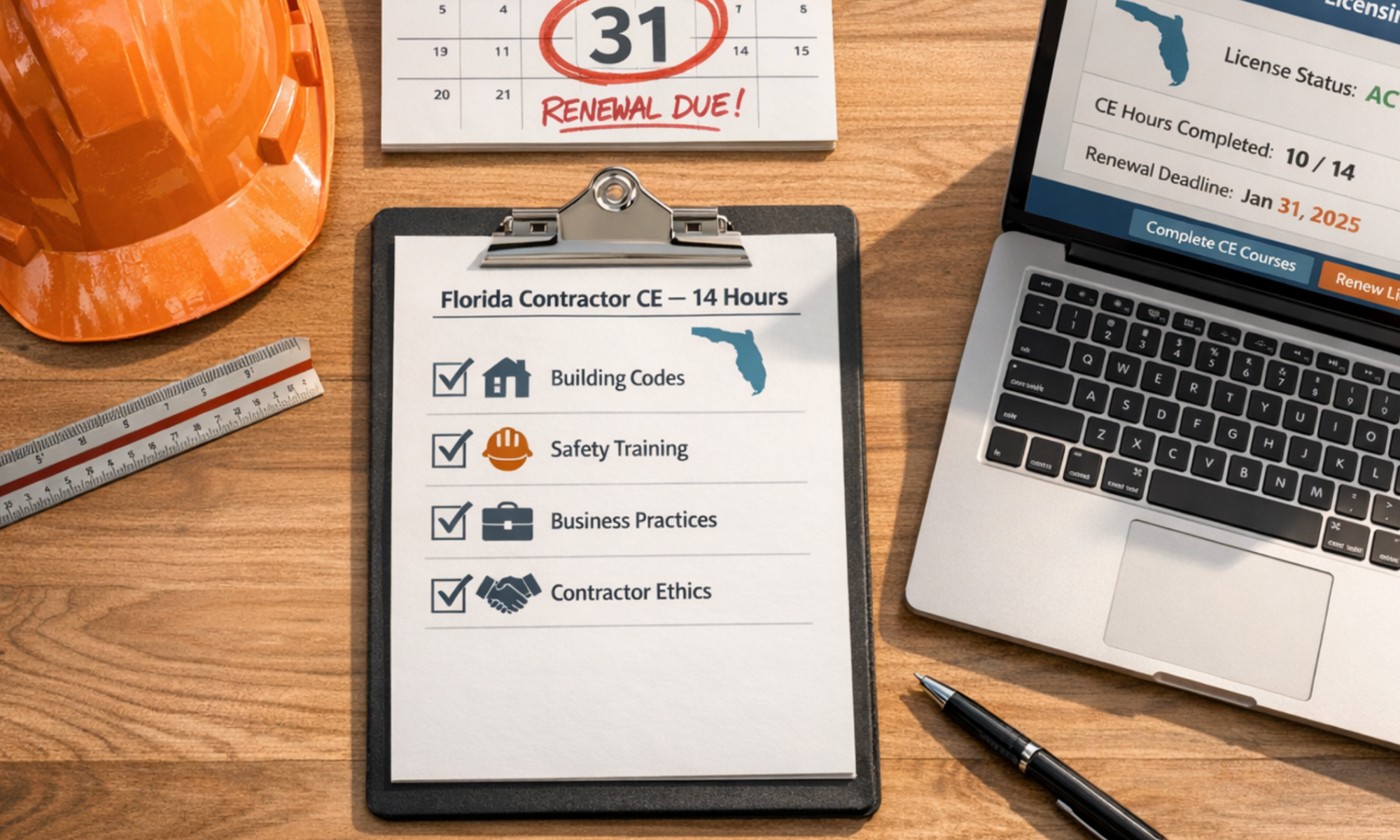
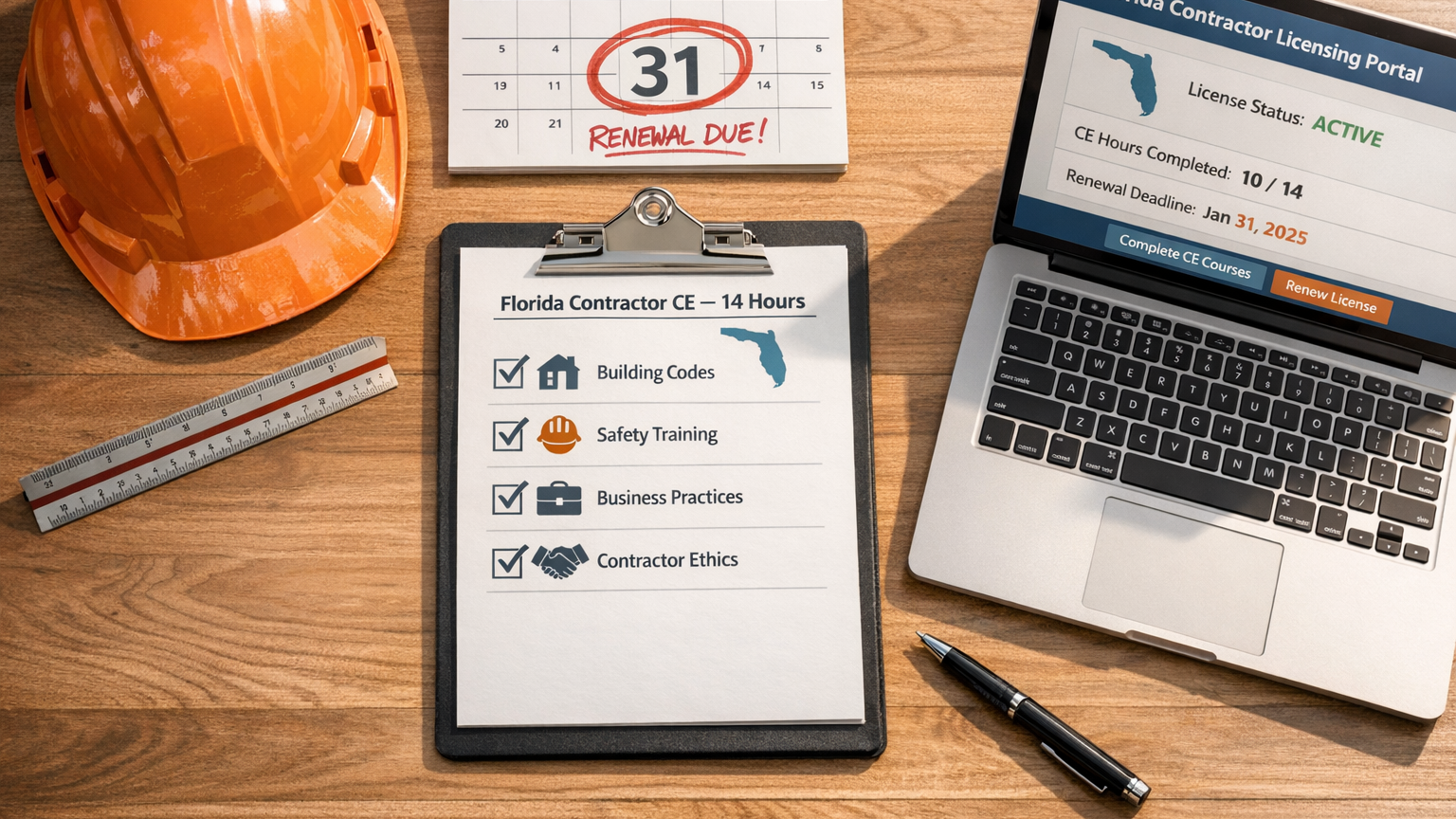
If you’re a Florida contractor, staying licensed means completing 14 hours of board-approved Continuing Education (CE) every two years. This applies to both Certified contractors (statewide licenses) and Registered contractors (local jurisdictions). Here’s what you need to know:
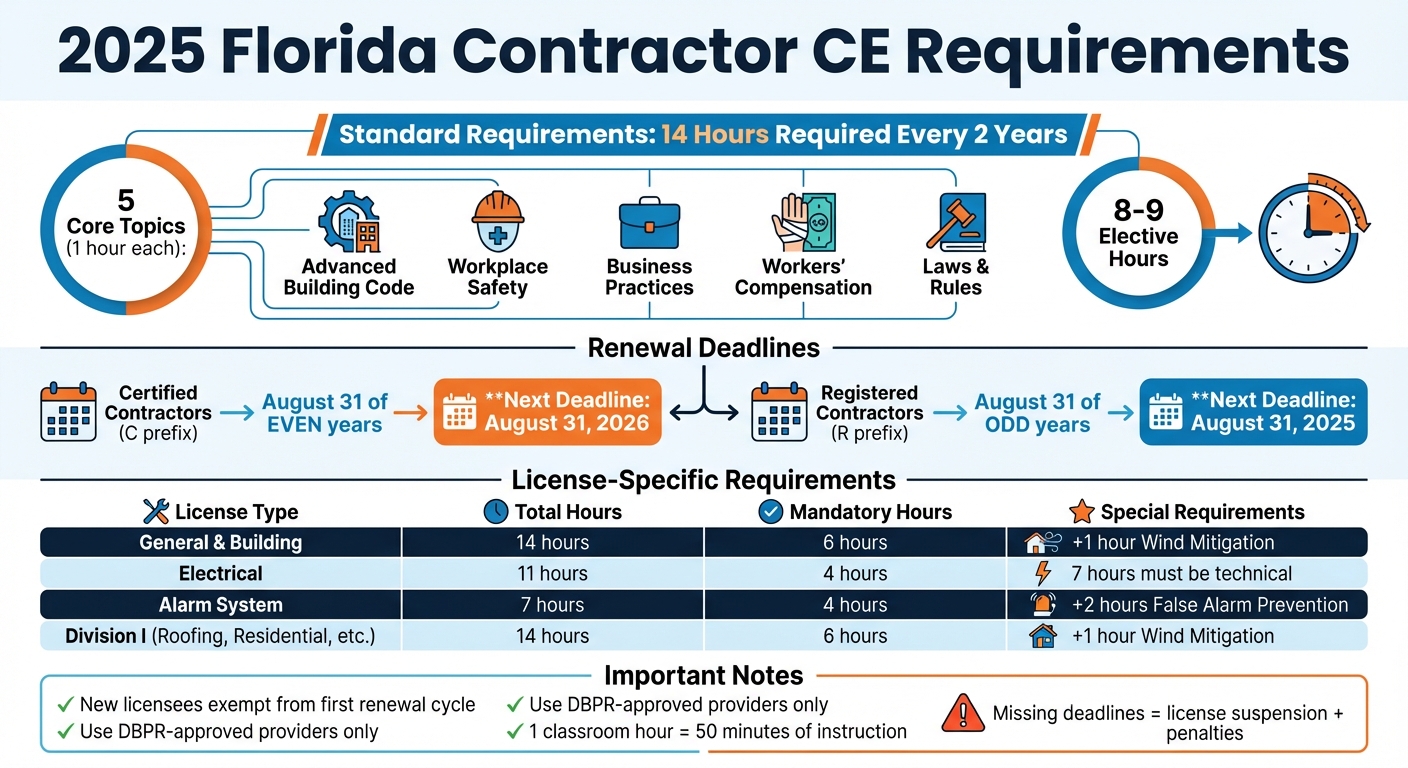
Mandatory Hours: 5 core topics (1 hour each) covering Workplace Safety, Workers’ Compensation, Business Practices, Construction Laws & Rules, and Advanced Building Code.
Additional Requirements: Division I contractors (e.g., General, Building, Roofing) need 1 extra hour on Wind Mitigation. Pool/Spa contractors require 1 hour of Pool Electrical training.
Renewal Deadlines:
Certified contractors: August 31 of even-numbered years (next: August 31, 2026).
Registered contractors: August 31 of odd-numbered years (next: August 31, 2025).
New Licensees: Exempt from CE in the first renewal cycle.
Complete CE hours via in-person, online, or distance learning courses. Ensure your provider is DBPR-approved and track your hours in your DBPR account. Missing deadlines can lead to license suspension and penalties. Start early to avoid last-minute stress.
CE Requirements Overview
Florida contractors must meet specific continuing education (CE) requirements as outlined by the Florida Construction Industry Licensing Board (CILB), which operates under the Department of Business and Professional Regulation (DBPR). These rules are based on Chapter 489, Part I of the Florida Statutes, which sets the standards for the biennial renewal cycle and CE obligations.
A “classroom hour” is defined as 50 minutes of instruction. So, when a course claims to be one hour, it includes 50 minutes of teaching. This distinction is helpful for planning, especially if you’re completing multiple courses in one day.
Contractors are required to complete 14 CE hours, which can be done through in-person classes, online courses, or interactive distance learning. If you opt for online courses, make sure the provider has a “C / I” or “I” designation to ensure your hours are accepted.
New licensees are generally exempt from CE requirements during their first renewal cycle. This gives newly licensed contractors a chance to focus on establishing their business before taking on educational commitments. Be sure to check the renewal deadlines specific to your license type.
Biennial Renewal Deadlines
Your renewal deadline depends on whether you hold a Certified or Registered contractor license. Registered contractors (whose license numbers start with “R”) must renew by August 31, 2025. On the other hand, Certified contractors (identified by a “C” prefix) follow a different schedule, with renewals due on August 31 of even-numbered years. Their next deadline is August 31, 2026.
Missing your renewal deadline can result in your license lapsing, which means you can’t legally operate. It may also lead to late fees and complications with insurance or ongoing contracts. To avoid these issues, it’s a good idea to complete your CE hours well before the deadline. This ensures your course provider has enough time to report your hours to the DBPR system.
Standard CE Hour Requirements
Most Florida contractors are required to complete 14 hours of CE during each two-year renewal cycle. This rule applies to both Certified and Registered contractors, regardless of license type. The 14 hours are divided into mandatory core topics and elective options.
The five core topics include one hour each of: Advanced Florida Building Code, Workplace Safety, Business Practices, Workers’ Compensation, and Laws & Rules. These five hours are non-negotiable. For Division I contractors – such as General, Building, Residential, Roofing, Specialty Structure, and Glass and Glazing contractors – there’s an additional one-hour requirement for Wind Mitigation Methodology, bringing their mandatory hours to six.
The remaining 8–9 hours can be used for electives or technical training. This flexibility allows contractors to focus on areas that align with their business needs, whether that’s advanced project management, emerging construction technologies, or specific trade skills.
Contractors with inactive licenses are not required to complete CE hours. However, reactivating an inactive license will require proof of 14 completed CE hours from the last or current renewal period. If you hold multiple licenses, you might be able to apply certain credits across different license types through cross-crediting.
To stay on top of your progress, track your CE hours through your DBPR account. While course providers are responsible for reporting your completed hours, it’s important to double-check that the hours are correctly logged in your account well before the renewal deadline. This extra step can save you from last-minute headaches.
CE Requirements by License Type
When it comes to continuing education (CE) for Florida contractors, the specific requirements vary depending on your license type. While most contractors need to complete 14 hours of CE, the exact courses and topics you must cover depend on your license category. These variations determine the mandatory subjects and how many elective credits you can choose.
General and Building Contractors
For General and Building contractors, the standard 14-hour CE requirement applies. Out of these, six hours are mandatory and include the following core topics: Advanced Module Building Code, Workplace Safety, Business Practices, Workers’ Compensation, and Laws & Rules. Additionally, contractors in this category must complete one hour focused on Wind Mitigation Methodology.
If you’re newly licensed, your CE requirements may differ based on how long you’ve held your license before the first renewal deadline. Here’s how it breaks down:
Licensed for less than 12 months: You’re exempt from CE requirements for your first renewal cycle.
After that initial renewal, the full 14-hour requirement kicks in for all subsequent cycles.
Electrical and Alarm Contractors
The CE requirements differ significantly for Electrical and Alarm contractors compared to General and Building contractors.
Electrical Contractors: They need to complete 11 hours of CE, with a strong focus on technical subjects – 7 of those hours must be technical. The remaining four hours are divided into one hour each for Workers’ Compensation, Workplace Safety, and Business Practices. Unlike Division I contractors, Electrical contractors are not required to take the Wind Mitigation Methodology course.
Alarm System Contractors: Their CE requirement is only 7 hours per renewal cycle. This includes one hour each for Workers’ Compensation, Workplace Safety, Business Practices, and technical subjects, along with 2 hours dedicated to False Alarm Prevention. This additional focus aims to reduce false dispatches and foster better relationships with local law enforcement.
A unique benefit for Electrical contractors is the ability to apply certain technical CE hours to both their Construction Industry Licensing Board (CILB) and Electrical Contractors’ Licensing Board (ECLB) licenses. These tailored requirements allow contractors to address the specific challenges of their fields while aligning with Florida’s broader CE guidelines.
Required CE Course Topics
Florida’s continuing education (CE) program is designed to ensure contractors stay informed about key topics critical to their profession. These required courses focus on business, legal, and safety principles that directly influence your day-to-day responsibilities.
Workers’ Compensation
Every renewal cycle, contractors must complete one hour of workers’ compensation training. This course delves into Florida’s workers’ compensation laws, helping you understand employer responsibilities and reduce financial risks tied to workplace injuries.
This training isn’t just about meeting legal requirements – it also protects your business. As Metalcon highlights:
A strong workers’ compensation strategy can help metal construction companies reduce risk, retain skilled workers, and improve jobsite safety.
Additionally, tools like the Construction Policy Tracking Database can simplify compliance by sending automatic updates on coverage changes. These insights are invaluable for staying ahead of potential risks.
Workplace Safety
Workplace safety training ensures contractors are up-to-date with OSHA standards and Florida’s building codes. Topics include recognizing hazards, fall protection measures, proper equipment use, and emergency response protocols – essential knowledge for maintaining safe job sites.
Business Practices
The one-hour Business Practices course focuses on managing project funds, handling payroll, and making ethical decisions regarding employees and subcontractors. These lessons align with Florida’s CE requirements, equipping you with tools to run a compliant and financially stable business.
Trade-Specific Technical Topics
In addition to the core curriculum, electives are available to refine your trade-specific expertise. For instance, electrical contractors can explore the National Electrical Code, emerging technologies, or safety practices tailored to their field. Similarly, plumbing or HVAC professionals might choose courses on medical gas systems, backflow prevention, refrigeration design, or environmental considerations. These electives are a great way to stay current with advancements that directly impact your trade.
Palm Construction School CE Courses
Palm Construction School provides courses tailored to meet Florida’s continuing education (CE) requirements for construction professionals. As a DBPR-approved provider, the school offers courses led by licensed instructors who bring both practical knowledge and regulatory expertise to the table.
You can choose between in-person or online courses, both designed to fit around your schedule while adhering to Florida’s current regulations and building codes. The course materials are regularly updated to reflect the latest standards.
The curriculum covers all mandatory topics outlined by the Florida Construction Industry Licensing Board (CILB). This includes Advanced Building Code, Workers’ Compensation, and Business Practices. The program fulfills the 14-hour CE requirement every two years, with content tailored to specific trade licenses.
How to Enroll
Signing up is simple. Visit www.palm-school.com or call 1-800-732-9140 to get started. The enrollment process helps you choose courses that match your license type and preferred learning format.
Once enrolled, you’ll gain immediate access to course materials and scheduling details. Online students can begin their coursework right away, while in-person participants will receive information on class locations and dates. Since Palm Construction School is DBPR-approved, every course you complete counts directly toward your license renewal.
How to Complete CE Requirements Efficiently
Planning ahead can make meeting your certification requirements much easier. To tackle the 14-hour Continuing Education (CE) requirement without stress, start early and space out your courses throughout the renewal cycle. Don’t wait until the last minute – this can lead to unnecessary pressure.
A smart way to handle your CE credits is to enroll in a 14-hour course package that includes all the mandatory topics: Advanced Building Code, Workers’ Compensation, Business Practices, Workplace Safety, and Laws and Rules. This ensures you meet all compliance standards. Once enrolled, it’s equally important to know how to keep track of your completed CE hours.
Tracking Your CE Hours
While your course provider will report your CE hours to the Department of Business and Professional Regulation (DBPR), it’s a good idea to maintain your own records. Keep copies of your certificates and periodically check that your hours are accurately recorded. Remember, it’s your responsibility to ensure your records are correct.
If your license requires a Wind Mitigation course – such as for General, Building, Residential, Roofing, Specialty Structure, and Glass and Glazing contractors – make sure this specific hour is logged. This requirement applies to Division I licenses, so double-check your records to avoid any issues.
Common Mistakes to Avoid
To make the renewal process even smoother, steer clear of these common pitfalls. One frequent error is completing 14 general CE hours but missing one or more of the required topics. Another issue comes from misunderstanding renewal cycles: Certified contractors (license prefix “C”) renew in even-numbered years (e.g., 2026), while Registered contractors (license prefix “R”) renew in odd-numbered years. Mixing up these timelines could result in late fees or even license suspension.
Also, confirm that your CE courses are provided by a DBPR-approved provider. Check for their provider number – courses from unapproved providers won’t count toward your requirement. If you’re a newly licensed contractor, you’re likely exempt from CE requirements until your first full renewal period, so don’t waste money on unnecessary courses.
Lastly, make sure your email address is up to date with the DBPR. Florida law requires licensees to maintain valid contact information to receive renewal notices and other important communications. Missing updates due to outdated contact details could complicate your renewal process.
Conclusion
Meeting Florida contractor continuing education (CE) requirements doesn’t have to be complicated. To maintain your license, you’ll need 14 hours of CE, covering essential topics like Workplace Safety, Workers’ Compensation, Business Practices, Laws and Rules, and Advanced Building Code. If you hold a General, Building, Residential, Roofing, Specialty Structure, or Glass and Glazing license, you’ll also need an additional hour focused on Wind Mitigation.
Keep the August 31 renewal deadline in mind. Certified contractors (license prefix “C”) renew in even-numbered years (like 2026), while Registered contractors (license prefix “R”) renew in odd-numbered years. Missing your renewal date can lead to penalties, so it’s a good idea to keep track of your cycle.
To make staying compliant easier, choose a CE provider that covers all the bases. Palm Construction School offers everything you need to fulfill your 14-hour requirement in one convenient place. Their DBPR-approved courses, taught by licensed instructors and regularly updated, are tailored specifically for Florida contractors – ensuring you meet every requirement for your license.
FAQs
continuing education (CE) every two years to keep their licenses active. These 14 hours must cover at least one hour in each of the following areas:
Workplace safety
Workers’ compensation
Business practices
Advanced module building code
Laws and rules
Depending on the type of license and the contractor’s area of expertise, additional training in wind mitigation methods may also be necessary. Keeping up with these educational requirements not only ensures compliance with state laws but also helps contractors stay informed and improve their skills.
New Florida contractors need to prepare for their first continuing education (CE) renewal by familiarizing themselves with the state’s requirements. Generally, they are required to complete 14 hours of approved CE courses within their initial two-year renewal period. These courses cover essential topics like workplace safety, business practices, industry laws and rules, and wind mitigation.
Pay close attention to your renewal deadline, which is typically August 31 of either even or odd years, depending on your license type. Starting early is key to avoiding last-minute stress. Make sure to select approved CE providers to ensure your courses meet state standards. Staying organized and keeping track of your progress can make the renewal process much smoother.
If you’re a contractor in Florida and miss the continuing education (CE) renewal deadline, your license could become inactive or even lapse. This means you’d no longer be legally allowed to perform contracting work until you’ve completed the necessary CE credits and successfully renewed or reactivated your license.
To keep your business running smoothly, it’s crucial to stay ahead of your CE requirements and renewal deadlines. Completing your credits on time keeps your license active and ensures you’re meeting state regulations.
Getting licensed as a contractor in Florida is a major milestone — and it begins with passing one or more DBPR (Department of Business & Professional Regulation) exams. At Palm Construction School, we prepare students for these tests, and in this post, we’re breaking down how the exams work, what they cover, and how to get ready.
1. Overview: Which Exams You’ll Need
According to Florida’s Construction Industry Licensing Board:
Division I contractors (General, Building, Residential) must pass three exams:
Business & Finance
Contract Administration
Project Management
Division II contractors (specialty trades) must pass two exams:
Business & Finance
Trade Knowledge (for their specialty)
All exams are computer-based (except some paper-and-pencil options for certain trade tests) and are open-book.
2. Exam Details: The Business & Finance Portion
This is required for nearly every contractor license in Florida. Here’s the breakdown:
Format: Multiple-choice
Number of Questions: ~120–125 (some include pilot items)
Time Limit: 6.5 hours (390 minutes)
Passing Score: 70% (about 84 correct out of 120 scored questions)
Testing is done at Pearson VUE centers for computer-based parts.
Be sure to submit your application and fees at least 30 days before your desired exam date.
6. Tips for Success
Use Approved Reference Books: The exam is open-book, so know which Florida-approved texts are allowed.
Time Management Matters: With long exams, practice pacing yourself.
Practice Exams Pay Off: Use timed practice tests to simulate test day.
Study Strategically: Focus heavily on high-weight topics like accounting, business structure, and administrative tasks.
Leverage Prep Services: Consider class prep, tutoring, or study groups.
Final Thoughts
The Florida contractor exam process is rigorous, but knowing exactly which parts you need to pass, how much time you’ll spend, and what topics carry the most weight can make your preparation much more effective. Whether you’re preparing for a building, pool, or specialty trade license, having a structured study plan is key. If you’re ready to go all in on your exam prep, Palm Construction School is here to support you every step of the way — from live courses to tutoring and study aids.
Scheduling your Florida contractor exam is straightforward but requires careful planning. Here’s a quick summary to get started:
Understand Exam Dates: You may take most construction licensing exams any time of year. Plumbing exams are the exception—they are held six times a year.
Submit Application Early: Apply and pay fees at least 30 days before your desired exam date.
Know the Costs: Exam registration costs $135, plus $80 for each exam you schedule.
Prepare Documents: On testing day, you’ll need to bring with you a valid photo ID and the required reference books.
Schedule viaPearson VUE: Once approved, create an account on Pearson VUE to book your exam sections.
Key Tip: Plan ahead to secure your preferred date and avoid delays. If you need to reschedule, do so at least two days before the exam to avoid losing fees.
For detailed steps, fee breakdowns, and preparation tips, read on!
FL Contractors Exam PearsonVue Registration Process
Types of Contractor Exams Available
The exam is divided into several parts, including Business and Finance and Trade Knowledge, and sections tailored to specific specialties. Depending on the category, exam durations range from 5 to 7.5 hours. General, Building, and Residential contractors are required to complete three main sections: Business and Finance, Contract Administration, and Project Management. Specialty contractors, like Tower Specialty or Demolition Contractors, take exams focused on their specific expertise.
Pearson VUE administers the exam through computer-based testing, offering flexible scheduling, instant score results, and a secure testing setting. Each section requires separate registration and payment through their system. This setup allows candidates to plan their exams based on their readiness.
Understanding the exam’s structure is key to scheduling effectively. You’ll need to allocate enough time for each section and align your study plan with the available test dates.
Documents and Fees for Exam Scheduling
Exam Registration
Visit Professional Testing‘s website to register for your exam. Completed applications for test registration must be submitted at least 30 days before your preferred exam date. Once processed, you’ll get a Registration Receipt via email, which you’ll need to schedule your exam with Pearson Vue.
Exam Fees and Payment Information
The Florida contractor exam involves separate fees for its various components:
Fee Type
Amount
Payable To
Registration Fee
$135.00
Professional Testing, Inc.
Business and Finance
$80.00
Pearson VUE
Trade Knowledge
$80.00
Pearson VUE
Contract Administration
$40.00
Pearson VUE
Project Management
$40.00
Pearson VUE
Payment Methods: You can pay online using a credit card or send separate checks/money orders to the respective organizations. For paper-based tests, there’s an additional $80 exam site administration fee, payable to the Florida DBPR.
Important Notes: Exam fees are non-refundable and non-transferable. Keep your payment confirmations, as all fees must be cleared before you can schedule your exam. A $25 penalty applies for returned checks or declined card payments.
Once your documents are submitted and fees are paid, you’re all set to schedule your exam through Pearson VUE. The next section will guide you through the scheduling process step-by-step.
After registering with Professional Testing and receiving confirmation, follow these steps to schedule your exam:
Create Your Pearson VUE Account Head to the Pearson VUE website and set up an account. Make sure to use your legal name exactly as it appears on your government-issued ID. Any mismatch could result in being turned away on exam day.
Choose Your Exam Sections and Schedule Log into your Pearson VUE account and select the exam sections you need (such as Business and Finance, Trade Knowledge, Contract Administration, or Project Management). Pick a testing center and appointment date from the available options. You can schedule your exam as late as one day in advance, depending on availability.
Rules for Rescheduling or Canceling
Carefully plan your exam date to avoid unnecessary complications. If you need to change your schedule, make sure to do so at least two days ahead of your exam to avoid losing your fees. Keep in mind that last-minute changes can limit your options and delay the licensing process.
Rescheduling Guidelines:
Adjust your schedule online through your Pearson VUE account or by phone.
No extra fees are charged for changes made more than two days before the exam.
Changes made within two days of the exam result in forfeited fees.
If you miss your exam, you’ll need to reapply and pay the fees again.
Important Deadlines:
For specialized exams, refer to the bi-monthly schedule.
Confirm your application status with Professional Testing before the listed deadline.
Once your exam is scheduled, the focus shifts to preparation – make sure you’re ready to perform your best.
Getting Help with Scheduling Issues
If you run into problems during registration or scheduling, there are reliable support options to help you out:
Pearson VUE Support: Reach out to Pearson VUE at 888-204-6230 for help with scheduling, rescheduling, or technical issues. You can cancel or reschedule without a fee if you do so at least two full calendar days before your test date.
DBPR Assistance: For more complex concerns, like application status or licensing questions, contact DBPR at 850-487-1395.
Most testing centers are located in Central Florida, and the exact location will be listed on your admission slip. Staying in touch with these support channels can help you navigate any hiccups in the scheduling process.
As we step into 2026, there’s no better time to set your sights on obtaining your Florida contractor’s license. Whether you’re just starting out in construction or looking to grow your existing business, earning your license can open up new opportunities and solidify your reputation in the industry. Here are the top reasons why now is the perfect time to make licensing your top priority.
1. Unlock Bigger and Better Projects
A contractor’s license is your ticket to bidding on larger, more lucrative projects. Licensed contractors are eligible to work on state and federally funded jobs, commercial developments, and high-value residential projects. These types of opportunities can significantly boost your earnings and help your business grow. Without a license, you may be restricted to smaller, lower-paying projects, limiting your potential for success.
In Florida, where construction demand continues to rise due to population growth and economic development, having a license ensures you can compete for the best jobs in a thriving market.
2. Gain Credibility and Trust
Being a licensed contractor sets you apart as a professional who meets the industry’s standards for knowledge, safety, and ethics. For homeowners, developers, and business owners, hiring a licensed contractor provides peace of mind that their project will comply with regulations and be completed by someone who is qualified.
Having a license isn’t just a requirement—it’s a marketing tool. Displaying your license number on your website, business cards, and proposals demonstrates transparency and professionalism, making it easier to attract clients who value quality work.
3. Comply with Legal Requirements
In Florida, performing contracting work without a license isn’t just risky—it’s illegal. Unlicensed contractors face heavy fines, legal action, and even the potential shutdown of their operations. By obtaining your license, you not only protect yourself from these risks but also ensure your work adheres to state regulations.
Moreover, licensed contractors are eligible to pull permits, a key requirement for many types of construction projects. Without a license, you may find yourself limited in the scope of work you can perform, potentially missing out on major projects.
4. Boost Your Earning Potential
A contractor’s license can significantly increase your earning potential. Licensed contractors have more access to higher-paying projects and are often able to command higher rates for their services.
Additionally, being licensed opens the door to business ownership. You can hire employees, take on subcontractors, and expand your operations, leading to even greater profitability. The investment of time and money in obtaining your license pays off in the form of long-term career growth and financial security.
5. Position Yourself for the Future
As the construction industry evolves, licensing is becoming more important than ever. Regulatory standards are increasing, and more clients are requiring proof of licensure before hiring contractors. By getting your license now, you’ll stay ahead of the curve and position yourself for long-term success in a competitive market.
Make Licensing Your 2026 Resolution
The Florida contractor’s licensing exam may be challenging, but it’s worth the effort. With the right preparation—such as enrolling in courses, utilizing tutoring services, and practicing with mock exams—you can pass the test and secure your license.
Don’t wait until the opportunities pass you by. Make 2026 the year you elevate your career by getting licensed. Ready to get started? Palm Construction School is here to guide you every step of the way!

 Student Login

 Call: 407-345-0096